
Alexandre da Trindade, PhD, Faculty of Education, University of Cambridge (CLAREC co-founder)
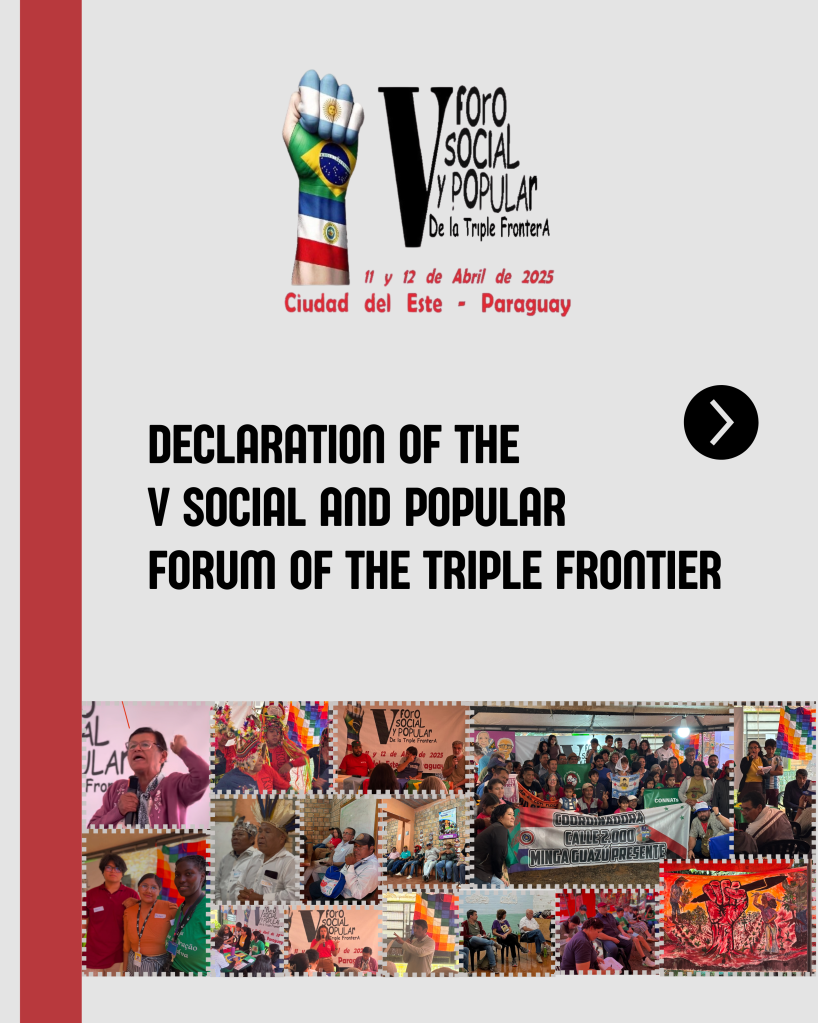
From Latin America’s Triple Frontier: resistance, memory, and collective power. On April 11–12 in Ciudad del Este, CLAREC supported the V Social and Popular Forum of the Triple Frontier, which brought together social movements from across the region. It was a space for collective resistance, grassroots regional integration, and the defence of hard-won rights in the face of authoritarianism and extractivism. Read here the full declaration.
V Social and Popular Forum of the Triple Frontier – April 2025
On April 11–12, grassroots organisations from Paraguay, Brazil, Argentina, and across Latin America gathered in Ciudad del Este for the V Social and Popular Forum of the Triple Frontier — a space for collective resistance, regional integration from below, and defence of hard-won rights in the face of authoritarianism and extractivism.
Hosted at Añua Róga, a community centre led by Callescuela and CONNATs, the forum brought together Indigenous, peasant, feminist, student, labour, and community-based movements in two intense days of political dialogue and strategic coordination.
Discussions centred on:
✊ Agrarian reform, Indigenous rights, and agroecology
✊ Climate crisis, hydroelectric dams, and energy sovereignty
✊ Popular education and counter-hegemonic pedagogies
✊ Feminist struggles, gender-based violence, and LGBTQIA+ rights
✊ Precarious labour, trade union organising, and the solidarity economy
✊ State violence, criminalisation, and political imprisonment
✊ Communication as resistance to hegemonic narratives
✊ Youth leadership and the protagonism of children, adolescents, and young people in political decision-making
The forum’s final declaration denounces authoritarian rollbacks, environmental and territorial devastation, and the complicity of governments in repressing social movements. It reaffirms the demand for reparations from hydroelectric projects, the urgency of popular agrarian reform, and the protection of seeds, water, land, and collective memory.
CLAREC was present and stands fully committed to these struggles. Popular education is not just an approach — it is a political strategy to articulate grassroots resistance and build democratic alternatives. Events like this are a call to action for institutions in hegemonic contexts like Cambridge: to listen, to learn, and to align with the knowledge produced from the ground up.
📍 From the Triple Frontier, a clear message echoes: Organised peoples resist, reclaim, and rebuild. CLAREC walks alongside them.
📄 The full declarations are available here in Spanish, Portuguese, and English. More information about the Social and Popular Forum of the Triple Frontier here.
DECLARATION OF THE V SOCIAL AND POPULAR FORUM OF THE TRIPLE FRONTIER
The grassroots organisations gathered at the V Social and Popular Forum of the Triple Frontier position ourselves in favour of regional integration driven by organised peoples and their struggles, in solidarity with the daily battles of the working majorities. We understand these struggles as a confrontation with imperialism, particularly in a context where several of our governments display fascist and dictatorial elements and are themselves aligned with that same imperialism.
We are peasant, Indigenous, trade union, human rights, women’s, childhood, student, educator, and working-class neighbourhood organisations. We are an intergenerational collective – fighters of all ages – on equal footing. This reality brings us great joy and enriches our debates.
We are deeply concerned about policies that dismantle state mechanisms of support for the popular majorities, resulting in the erosion of rights, often with the complicity of the three branches of government. We reiterate the demand for historical reparations that hydroelectric dams owe to Indigenous and peasant communities. It is also essential to raise awareness about the profound challenges posed by climate change. Within the extractivist models we endure, we are troubled by the loss of sovereignty; the growing use of agrochemicals; the contamination of rivers, soil, and wetlands; the deforestation of native species and their replacement with exotic ones; and the commodification and monopolisation of seeds and land. These issues stem from the aggressive advance of corporate agribusiness over peasant territories, Indigenous lands, and their vast bodies of knowledge. For this reason, we reaffirm the urgent relevance and necessity of a comprehensive and popular agrarian reform, as well as the recovery, protection, and communal management and exchange of seeds.
We emphasise the need for the democratisation of communication and the strengthening of alternative and community media that expose the realities and struggles of our peoples. Only through such communication can we reclaim and value our popular and ancestral identities, and uphold our ongoing pursuit of memory, truth, and justice.
We denounce the structural violence manifested in the intensified repression of popular mobilisations, the criminalisation of community members and leaders, and the persecution of our impoverished populations – Indigenous peoples, peasants, children, and women. We are alarmed by the resurgence of dictatorial practices in the evictions of peasant, Indigenous, and urban communities, by the existence of political prisoners, and by the conditions of the penitentiary systems. We uphold that the active and leading participation of children, adolescents, youth, and women in decision-making spaces is essential for building a more just and inclusive society. We endorse the Dónde está Lichita (Where is Lichita?) campaign, as well as solidarity efforts with the peoples of Palestine, Venezuela, Cuba, Haiti, and Peru.
We commit to building joint actions within a shared agenda so that we may support each other’s struggles. United, our struggles grow stronger.
Ciudad del Este, 12 April 2025.
You can contact Alexandre Trindade at ad988@cantab.ac.uk, or view his web page at https://clarec.org/alexandre-da-trindade-e-oliveira/
 Cambridge Latin American Research in Education Collective