
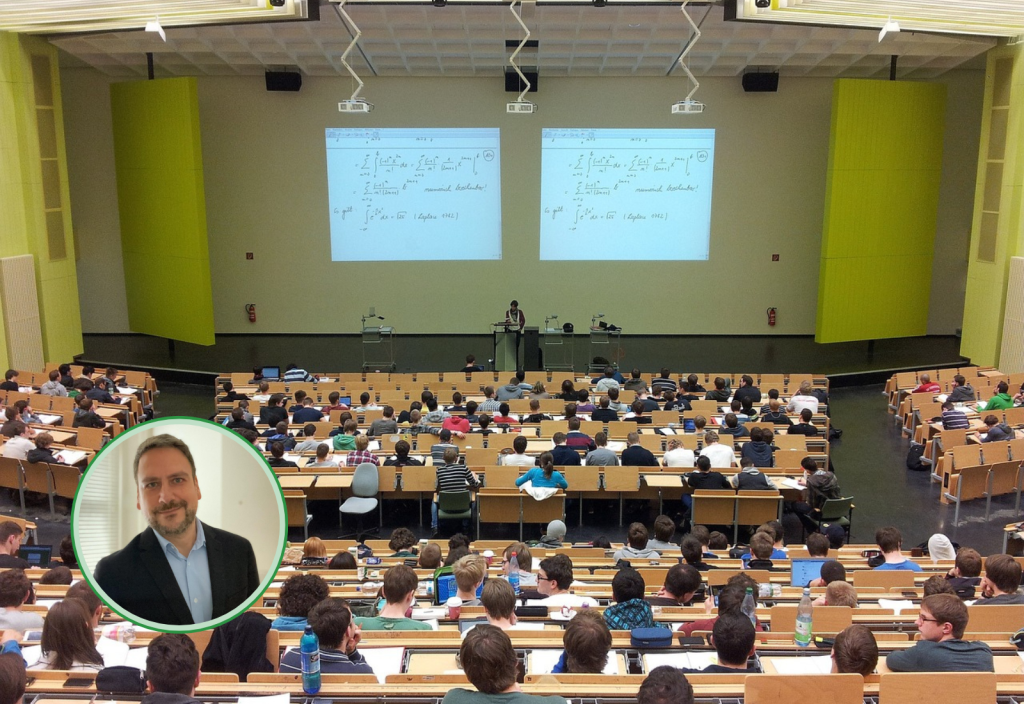
Alexandre da Trindade, PhD, Faculty of Education, University of Cambridge (CLAREC co-founder)
This post was originally published at The Review of Democracy
As universities face increasing neoliberal pressures, they must choose between passive complicity or transformative action. By embracing Paulo Freire’s concept of inédito viável—untested viability—and the framework of insurgent utopia, inspired by movements like the MST, universities can reclaim their potential as catalysts for radical societal transformation.
In a world increasingly shaped by neoliberal forces, universities face a profound choice: continue as complicit actors in the commodification of education or embrace their potential as institutions of transformation. Insurgent utopias offer a path to reimagine higher education as an active agent of societal change.
The idea of insurgent utopia, drawn from Paulo Freire’s work, is not a distant fantasy but a practical tool for change—a method of revolutionary action grounded in real-world struggles.
Recommended Post
How Do You Tear Down a Border? – Matthew Longo on the Pan-European Picnic and the Meaning of Freedom
Utopias have traditionally been viewed as abstract dreams, unreachable in the current reality. Freire, however, challenges this dominant notion with his concept of inédito viável—untested viability—a revolutionary framework that encourages oppressed groups to reimagine and actively work towards a future beyond their “limit-situations,” those socially imposed barriers that maintain oppression.
It is “untested” because it refers to possibilities not yet realised but perceived as achievable once the oppressed become conscious of their “limit-situations” and commit to overcoming them.
The revolutionary nature of inédito viável lies in its emphasis on collective action—transforming abstract hope into concrete reality through praxis.
This concept transcends theoretical speculation, functioning as a method for actively challenging oppression, as exemplified by the Landless Workers’ Movement (MST), which envisions agrarian reform not as a distant ideal, but as a tangible step toward dismantling “limit-situations,” such as inequalities in land ownership.
What makes insurgent utopia distinct is its practicality. It is not just a vision for the future, but a method of action grounded in the present. Through praxis, insurgent utopia encourages individuals to recognise not only their own oppression but also that of others, and to act collectively to dismantle these oppressive structures. It encourages a perpetual loop of collective reflection and action, where education and politics are inseparable.
In the book “Learning to Question: A Pedagogy of Liberation,” in a dialogue between Paulo Freire and Antonio Faundez, Faundez draws a parallel between this concept and the Myth of Sisyphus:
This possible dream will never be a fixed possible dream; it will be a possible dream that is continuously transforming, being created and re-created permanently, as the masses perceive that this possible dream eludes them, thus establishing a new possible dream. Essentially, it is the myth of Sisyphus: knowing that no possible dream will be fully attained.
The concept of insurgent utopia emerges as a proposal to, on one hand, broaden the scope of Freirean utopia, and on the other hand, facilitate a dialogue between a concept deeply rooted in the context of social struggles in the Global South and the intellectual traditions of the North—engaging, for example, with Ruth Levitas’s notion of “utopia as method“ and Erik Olin Wright’s idea of “real utopias.”
The untested viability represents that space where the possibility of transformation exists—where oppressed communities can organise, fight, and reimagine their conditions.
MST: Insurgent Utopia in Practice
The Landless Workers’ Movement (MST) in Brazil provides a vivid example of insurgent utopia in action. Founded in the 1980s as a response to severe land inequality, the MST mobilised landless families to reclaim unused or underutilised land and build communities grounded in collective ownership and agroecology. The MST’s struggle is not just about land—it is a fight for dignity, education, and autonomy.
Central to the MST’s philosophy is its commitment to “People’s Agrarian Reform,” a framework that goes far beyond traditional land redistribution. The movement seeks to create an alternative to the neoliberal model of agribusiness by empowering peasants to engage in sustainable agriculture, political education, and collective governance. This approach, deeply influenced by Freirean pedagogy, positions education as a form of resistance.
Freire’s inédito viável is at the heart of the MST’s approach. Rather than seeing land reform as an isolated goal, the movement integrates it into a broader struggle for systemic change. Through their political and educational initiatives, the MST not only fights for land rights but also builds the capacity for collective action and critical reflection among its members. This Freirean utopia frames land reform as part of a larger vision for societal transformation. The MST’s educational program merges political education with practical training, shaping educational policies in collaboration with universities to meet the needs of rural communities. This approach has resulted in increased access to education, improved infrastructure, and more culturally relevant curricula, as seen in the National Education Program in Agrarian Reform Areas (PRONERA). As Rebecca Tarlau argues, the MST’s efforts extend beyond land occupation to the occupation of schools, aiming to transform educational systems on a national scale. Furthermore, their agroecological practices challenge the capitalist model of land use while empowering communities through cooperative, sustainable farming, seed sovereignty, sustainable food production, and the development of renewable energy—embodying the revolutionary potential of Freire’s framework.
The MST exemplifies the Freirean idea that education is not neutral—it either serves to perpetuate inequality or to challenge it. Their pedagogy is inherently political, aimed at transforming oppressive realities.
Universities and the Crisis of Neutrality
Universities have been unable to prompt similar grass root movements like the MST. While the MST arises from the ground up, driven by collective action and resistance, universities have often succumbed to neoliberal pressures, becoming depoliticised and aligning more closely with market demands rather than broader societal needs.
The commodification of education—where students are treated as consumers and knowledge as a product—reflects the broader neoliberal capture of institutions that should be sites of resistance.
The question, then, is whether universities can break free from this cycle of complicity. Freire’s framework offers a way forward. By embracing insurgent utopia, universities can transform themselves into spaces of radical pedagogy and action. Rather than passively observing social struggles from the ivory tower, universities can actively participate in them, aligning with movements like the MST to challenge systemic inequality. The role of universities should be one of active participation in societal transformation, where education becomes an agent of empowerment, not a mechanism for maintaining the status quo.
Reclaiming the University’s Third Mission
The third mission of universities—beyond teaching and research—encompasses diverse forms of engagement with place-based entities, such as local communities, and the practical application of knowledge for societal benefit. However, this mission has often been reduced to superficial community projects or corporate partnerships. To reclaim the transformative potential of this mission, universities must deepen their engagement with social movements. Insurgent utopia offers a blueprint for this realignment, where universities not only collaborate with movements but also learn from them.
Take, for instance, the MST’s educational programs. The Florestan Fernandes National School (ENFF), established by the MST, functions as a hub for political education, built on Freirean principles. The school is not a traditional institution; rather, it is a dynamic space where critical thought and action come together, preparing students not just to learn but to lead and organise within their communities. The ENFF is a concrete example of insurgent utopia in practice—where education is both a tool and a method for societal transformation.
The third mission of universities should not be about serving market interests but about engaging deeply with grassroots movements, fostering critical thought and action to reshape society.
A Call to Action for Universities
In the face of escalating global crises—climate change, authoritarianism, and rampant inequality—universities must make a choice. Will they continue to serve as neutral institutions, complicit in the maintenance of neoliberalism, or will they become insurgent utopian spaces that challenge the very systems perpetuating inequality?
Paulo Freire’s inédito viável provides a pathway for the latter.
In response to the contemporary societal challenges intensified by global crises, universities have a responsibility to step up. The time for neutrality has passed. Insurgent utopia can inspire universities to fulfil their true potential as agents of radical change, positioning them at the forefront of transformative societal shifts. The MST’s success in resisting the land-agribusiness complex, stronger than the corporatisation of the education sector, underscores the importance of collective organisation, political education, and resistance. Universities can learn from the MST by combining political awareness with action to effect systemic change. Freire’s inédito viável offers a framework for creating spaces of dialogue and collaboration with social movements. By moving beyond superficial engagement and reimagining their third mission as deeply connected to social struggles, universities can better resist neoliberal pressures and foster radical change, transforming both their structures and the broader societal systems they aim to serve.
This op-ed is part of the Utopia and Democracy series. Op-eds in this series draw on presentations delivered at the conference held under the same title on July 3 to 5, 2024, which was organized by the Utopian Studies Society/Europe and hosted by Zsolt Czigányik, Iva Dimovska, and Daryna Koryagina – members of the Democracy in East Central European Utopianism research group, CEU Democracy Institute – at Central European University’s Budapest campus.
You can contact Alexandre at alexandretrindade22fev@hotmail.com, or view his web page at https://clarec.org/alexandre-da-trindade-e-oliveira/
 Cambridge Latin American Research in Education Collective