What Might a Conference on Popular Education Look Like?
The second edition of the Freire Conference, “Building the bridge between popular education and university”, which took place between 17 and 21 October at the Faculty of Education at the University of Cambridge and in two academic institutions in Rio de Janeiro, Brazil, was an experience in that sense. It was an initiative organised by a collective of people based in multiple educational institutions and social movements which proposes to broaden the limits and cross the barriers that separate the academic communities (particularly those belonging to the most traditional and hegemonic institutions) from education and popular knowledge by promoting meetings, relationships and democratic spaces that have in common a striving for transformation and social justice.
The first edition of this conference took place in 2021, the year in which the birth centenary of educator Paulo Freire was celebrated. It emerged from a provocative challenge: to think and carry out a “popular conference”, which had its foundations and values based on Freire’s idea of “popular education”. For the Brazilian educator, popular education is carried out with the people, the oppressed or the marginalised classes, from a particular conception of a liberating, political and ethical education. An education oriented to the transformation of society which starts from the concrete and lived context to reach the theoretical context, requiring epistemological curiosity, problematisation, rigorousness, creativity, dialogue, the experience of the praxis and the protagonism of the subjects.
In this sense, a popular education conference proposal should be (i) essentially dialogical, rather than the typical academic-expository one in which the transfer of knowledge in a unilateral way is predominant; (ii) it must overcome meritocratic proposal selection criteria that assume that some knowledge is more important and valid than others and therefore deserves to be ‘selected or chosen’; and (iii) should break the hegemonic barriers of language, access, format or perspective that exclude or discourage the participation of individuals and groups marginalised by academia due to various limitations – in this way, actions concerned with accessibility and the free access to educational spaces must be a priority.
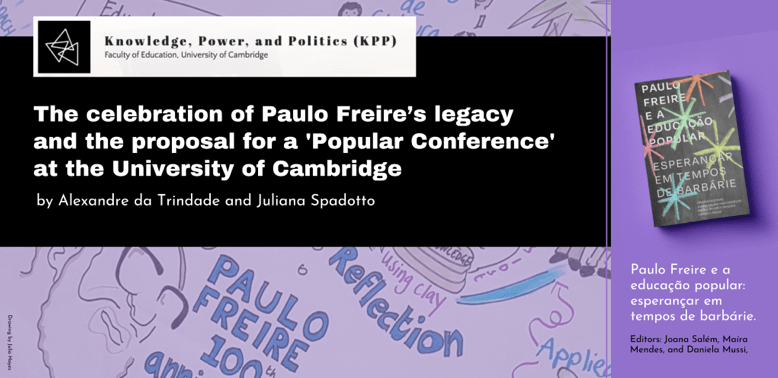
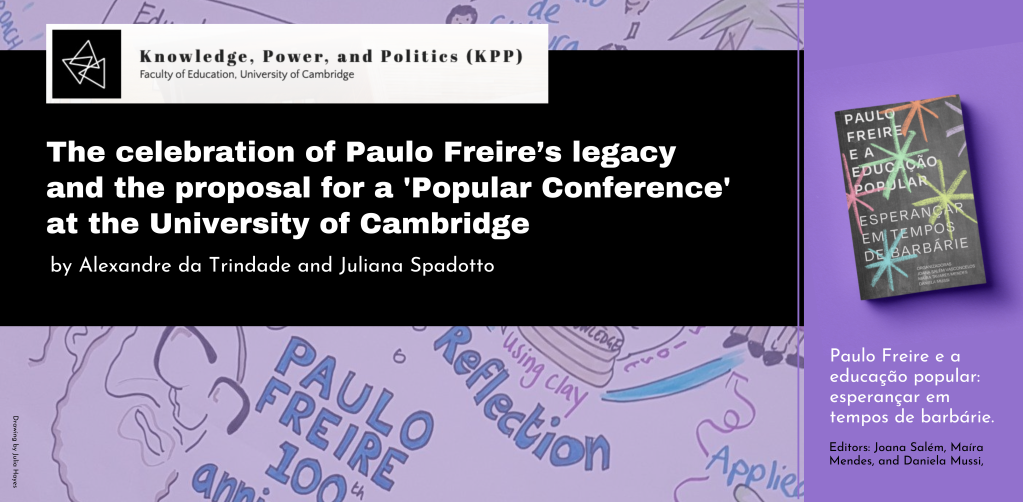
Based on those principles and purpose, the Cambridge Latin American Research in Education Collective (CLAREC) and the Brazilian popular education social movement Universidade Emancipa developed the 1st Freire Conference, “The Thoughts of Paulo Freire in the Current Research in Education”, at the University of Cambridge. That experience is described and shared by CLAREC members Alexandre da Trindade and Juliana Spadotto in a chapter of the book “Paulo Freire e a educação popular: esperançar em tempos de barbárie” (Paulo Freire and popular education: hope in times of barbarism) organised by Joana Salém, Maíra Mendes, and Daniela Mussi, to be launched in Portuguese in December 2022. This chapter has been translated into English and is now available at the Knowledge, Power, and Politics (KPP) Blog.
This question has stimulated us, the Cambridge Latin American Research in Education Collective (CLAREC) and the Universidade Emancipa, in the last two years.
The experience of the first edition of the Conference, which took place online and at the University of Cambridge in 2021, the year of the centenary of Paulo Freire’s birth, is shared by CLAREC members Alexandre da Trindade and Juliana Spadotto in a chapter of the book “Paulo Freire e a educação popular: esperançar em tempos de barbárie” (Paulo Freire and popular education: hope in times of barbarism) organised by Joana Salém, Maíra Mendes, and Daniela Mussi, to be launched in Portuguese in December 2022. This chapter has been translated into English and is now available at the Knowledge, Power, and Politics (KPP) Blog.
To find out more about the book and how to buy it, please access here. Drawing made by CLAREC Member Julia Hayes during the I Freire Conference.
 Cambridge Latin American Research in Education Collective